
The Surprise
how a life is rethought

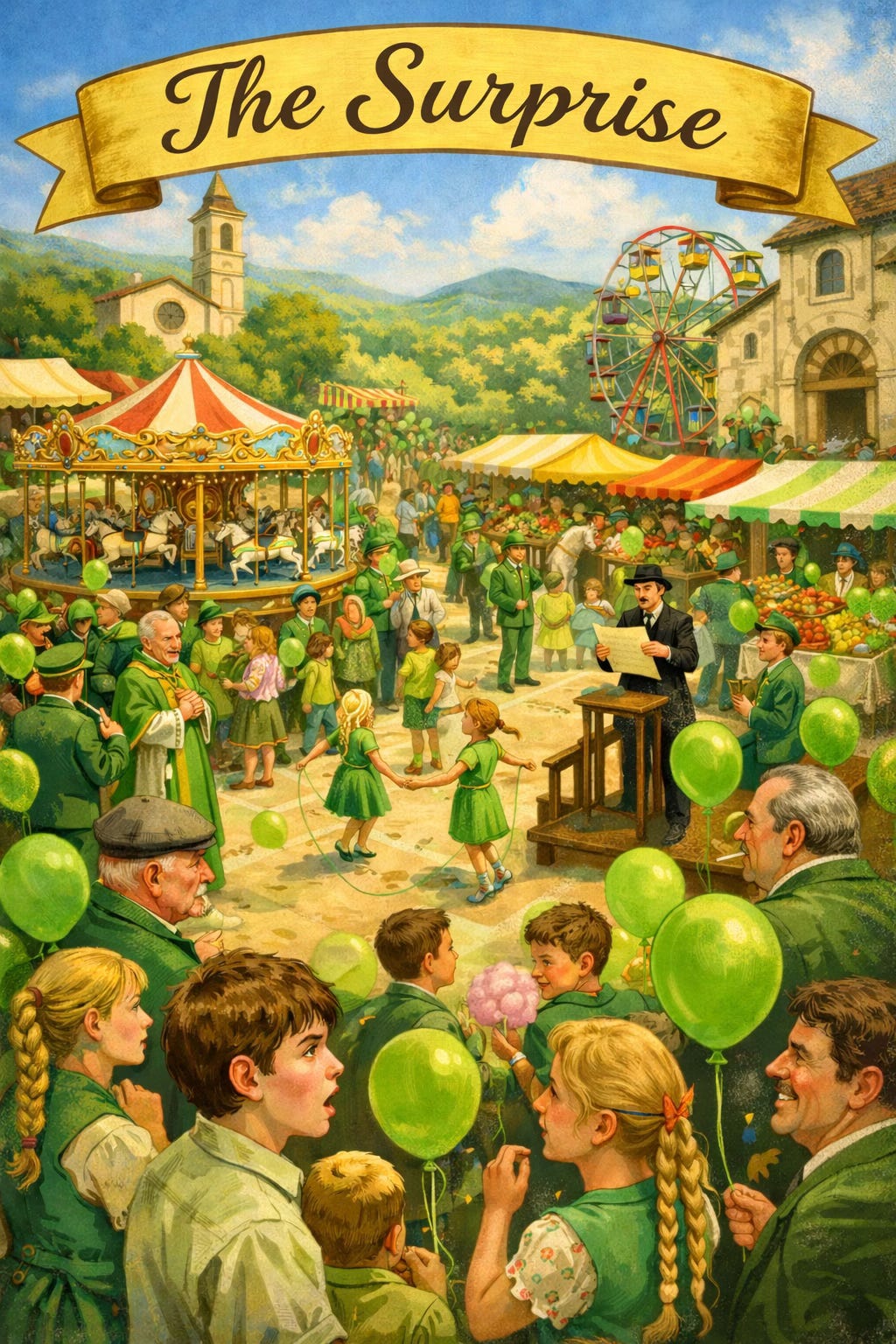
Everyone knew Uncle Alberto was strange, and honestly, when his letter arrived at our house, we weren’t very surprised. But inside it was a rather substantial check, and this departed a bit from the modest habits of the richest man in town. For a moment we thought Uncle had gone crazy. Looking more carefully at the contents, the letter didn’t really leave us much choice. I remember we immediately called Dad’s brother, and he too had received the letter and check, though truth be told, his was slightly smaller. A round of phone calls started among all the relatives: everyone had received a letter and check, and so had his closest friends. Hours passed in this telephone relay, and gradually we discovered that the entire town had received the fateful letter. Now, the town had about seven hundred souls, but that was still seven hundred people. I remember that for a week it was the same topic everywhere: at the pharmacy, at the cobbler’s, and while the plumber fixed your faucet, nothing else was discussed.
On Saturday, at the town square café, the sun shone brightly reflecting off the steel tables, and we learned that the largest check had been delivered to the parish priest. In short, we did a calculation and came to the conclusion that this eccentricity of Uncle’s had cost almost his entire liquid assets, at least according to what Giorgio, the banker, said—who, professional ethics be damned, had blabbed everything under the influence of beer and soda during a game of billiards.
A week later, we were waiting for him like so many pistachio ice creams—an entire town dressed in pistachio green under a scorching May. Each family had brought their basket of fruit, as requested in the letter, and a vendor was giving out strictly green balloons to all the children who asked. A screeching of bus brakes, and here came the band in green uniforms too, followed by the mayor with his green bow tie.
It was eleven in the morning and, as described in the letter, the poet arrived. A poet? I’d never seen a poet up close, here in Sverzoli. At most, in this town, we’d had the band. The poet was dressed in black, strictly all black, from his shoes to his hair. He took his place on the small stage set up by the mayor but paid for by Uncle. I looked at the valley where olive trees reigned and felt like I was in a fairy tale, one of those my grandfather used to tell me while holding my hand after school, as I ate my bread with butter and sugar. I loved bread with sugar and butter. The fruit, of which there was so much, gave off a wonderful smell that reminded me of the fruit vendor’s—yes, widow Agnese, who laughed her head off with that mole on her lip and the handkerchief stuffed with money she kept in the middle of her enormous bosom. That was also the only time I saw all nine Brancati brothers well-dressed and cleaned up.
Only a few minutes remained until Uncle’s arrival. The stalls were doing great business: in the various items, Uncle had also included “miscellaneous stall expenses,” calculating more or less what a family would spend while waiting and at the subsequent lunch. The smell of new clothes mixed with that of fruit and sweets: cotton candy, donuts... Chiara’s smiles—who, despite being a year younger than me, seemed older. I watched her jump rope while biting into an apple, with those blonde braids and those big green eyes. Each time I felt my throat tighten and I could never greet her except with a foolish smile, which she returned by tilting her head to the side. And finally my eyes fell on the school principal: that old fat nonconformist had taken the money and, dressed like everyone else, was smoking his horrible stinking Nazionale cigarettes. God, how I hated him!
“He’s coming!!” Giovanni suddenly shouted, the half-hunchbacked barber who tortured my hair with his infernal clippers and fetid breath. “He’s coming, see the dust?!” Giovanni shouted again. I looked down and a cloud of dust was following a carriage pulled by at least four horses. Uncle was right on time: in less than ten minutes he would arrive at the town square. There was a bit of commotion. The curiosity to know why we’d been summoned, and why he’d given away the money, was immense and was finally about to be satisfied. The poet quickly gulped down the sandwich he was eating and, imperiously, rose on the small stage, opening a scroll: “People! Listen to me, people! By the will of your fellow citizen Sir Alberto da Villarosa, I must read you a text, a single text, but only after his arrival!!” The excitement was sky-high, the band started up at full speed, the children’s shrieks were celebrations of life, and even the dogs ran around wildly, infected by that lively atmosphere that had been building. Then the clattering of the horses’ hooves became clearer, and finally a splendid white carriage, with white wheels, stopped in the center of all that pistachio green made of people. The windows of the long carriage were dark. The coachman dismounted; he was dressed entirely in white, almost blending in with it. He was very thin and had a strange smirk in his eyes: “Citizens of Sverzoli, listen to the poet; then Sir Alberto Villarosa will exit the carriage. Thank you.”
The band stopped playing. An unreal silence fell over the square, only a distant rooster broke the silence for a moment, and the poet read:
“The problem of salvation. We say: in the midst of life we die; God answers: On the contrary, in the midst of death you live. Written by Martin Luther.”
People started looking at each other. A soft murmur accompanied the opening of the carriage’s rear door, and a general mumble of astonishment followed the exit of a pistachio green coffin. The priest opened the church doors and adjusted his green ceremonial robe with golden ornaments.
Gianfranco Apuzzo